The small-firm reality
How a one- to five-person practice runs task management properly without an office manager, a bookkeeper on staff or an IT department. The advice published about task management for the small firm is mostly written for firms with an office manager, an accounts department and someone whose job is systems. Most South African practices are a husband-and-wife practice with a bookkeeper on Fridays — and at that size the partner drafting the pleadings is also the person chasing the invoice and remembering the diary. The constraint is not knowledge. It is that every process must run on almost no administrative time, because there is almost none to spend.
That constraint is clarifying. A small firm cannot afford process theatre — forms that exist to reassure, reports nobody reads, approvals that add a signature and no safety. What remains, if it is designed honestly, is a short list of things that genuinely keep the practice safe and solvent. This article is that list, applied to task management for the small firm.
What you can safely skip
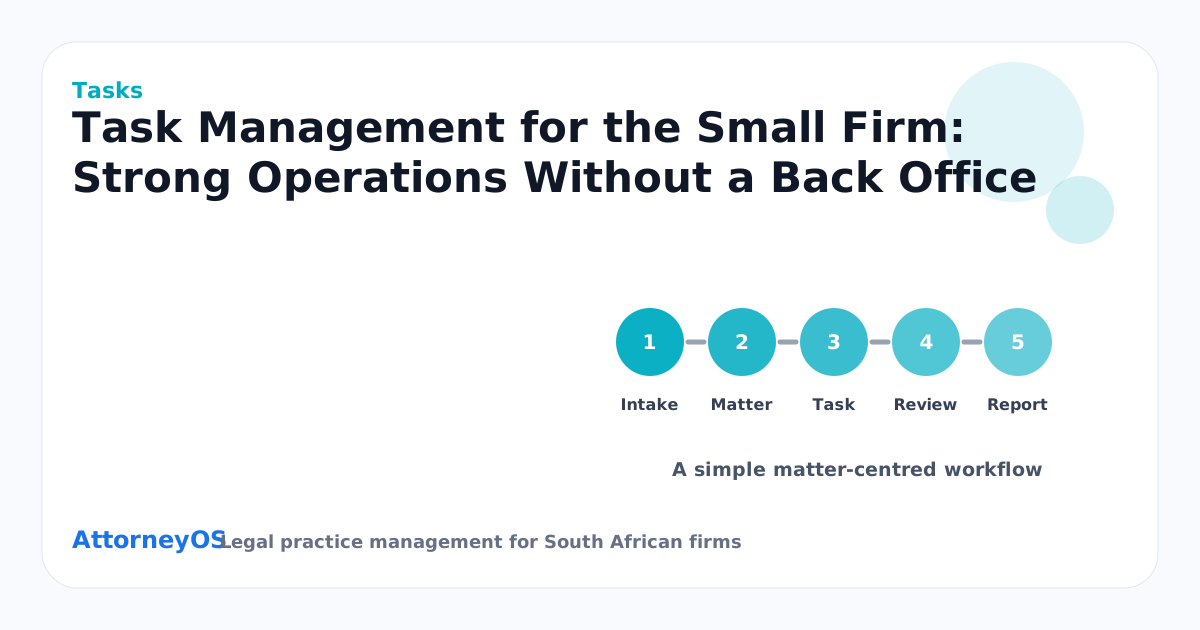
Skip anything that exists mainly to coordinate people you do not have: elaborate approval chains, multi-stage sign-offs, committee reviews. Skip duplicate capture — if it is on the matter, it does not also need a register, a spreadsheet and a whiteboard. Skip perfection in categorisation; a findable document beats a perfectly filed one. The discipline a small firm cannot skip is smaller than it fears: capture, ownership, dates, and one honest weekly look at the exceptions.
The minimum system
For task management for the small firm in a small practice, the minimum has four parts. Everything else is optional; these are not.
- One place where the work lives — the matter record, not an inbox, so that task management for the small firm is visible to whoever needs it, including you in six months.
- A name on everything. In a two-person firm this feels absurd until leave, illness or a court day makes it obvious which items were silently yours.
- A date on everything that can expire, prescribe, lapse or embarrass. Undated obligations are how small firms get surprised.
- One fixed weekly slot — twenty minutes is enough — to look only at exceptions: no owner, no date, no movement.
Two people, clear lanes
Where there is an assistant, paralegal or candidate, the division that works is capture versus judgment. The support role owns getting things onto the matter — documents filed, dates diarised, payments recorded, statuses current — and is trusted to do it without the attorney re-checking every entry. The attorney owns what the captured facts mean: which deadline matters, which client needs calling, which file is drifting toward risk. When both people work from the same record, handover stops being a meeting and becomes a glance.
The weekly rhythm
Small firms run on rhythm, not on heroics. Anchor task management for the small firm to fixed points: capture happens the day work arrives; the exception review happens the same twenty minutes every week; the monthly look — money, aging matters, anything trending wrong — happens the same morning each month. The fixed slot matters more than the duration. A rhythm the diary defends survives busy seasons; an intention does not.
The checklist
- Assign every task to a named person with a due date and priority.
- Use a board view for daily execution and filters for supervision.
- Link tasks to matters so context is never lost.
- Write down the minimum task management routine that must survive your busiest week.
- Pick one fixed weekly slot to review task management and defend it like a court date.
- Choose tools that one person can administer, because that person is you.
- Use a matter-centred workspace so task management is linked to clients, matters, tasks, diary, documents, billing and reports.
- Review the process with the responsible attorney and update the matter record before the week closes.
What waiting actually costs
The common small-firm position on task management for the small firm is "when we are bigger". The arithmetic runs the other way. At small scale the fix costs an afternoon and the habits are set with two people; at fifteen people the same fix is a project with training, resistance and migration. And the risks being carried meanwhile — the missed date, the unbilled work, the file only one person understands — do not wait for the firm to grow. Small is when this is cheap.
When the firm grows
The system above scales further than expected, because it was built on the parts that scale: single source of truth, ownership, dates, review. What changes with growth is permissions — more roles that should see less — and reporting, because the owner can no longer hold the whole practice in one head. If the foundation was laid at two people, adding the sixth is administration. If it was not, adding the sixth is the crisis that finally forces the foundation, at ten times the price.
FAQ
Is software worth it at this size?
The honest test: count the hours the practice spends weekly on retyping, searching, chasing and reconstructing task management for the small firm, and price them at the charge-out rate. For most firms the answer arrives quickly. For searchers comparing law firm task management, the small-firm criterion is administration weight — the right product is the one a busy practitioner can run without becoming its administrator.
What about the months with no time at all?
That is what the system is for. In a crunch, capture drops to its roughest form — a line on the matter — and the weekly review shrinks to ten minutes on exceptions only. A system that degrades gracefully under pressure and recovers afterwards is worth ten that demand perfection.
Keep building
Start smaller than feels ambitious: apply the checklist above to three live matters this week and let the gaps show themselves. Most firms discover that task management for the small firm improves quickly once the work is visible and owned — the hard part was never the theory. The related guides below go deeper on neighbouring topics, and when the firm wants to see law firm task management handled inside one matter-centred workspace, AttorneyOS offers a 7-day free trial with no card required.
Topics covered: Tasks, Deadlines, Small firm, Operations.
A note on professional duty
None of this replaces professional judgment. Task management for the small firm processes and software organise the work; the attorney remains responsible for the legal content, the deadlines the rules impose, and the duties owed to client, court and profession. Treat every checklist in this article as scaffolding for that responsibility — the point is to free attention for judgment, never to outsource it.
The economics of capture
It is worth doing the arithmetic once. A missed detail in task management for the small firm costs, conservatively, an hour of reconstruction: reading back through email, asking colleagues, re-establishing what was agreed. Capturing the same detail at source costs under a minute. At any realistic charge-out rate, the discipline pays for itself dozens of times over each month — and that calculation ignores the harder-to-price costs, the client's confidence and the attorney's evenings, which move in the same direction.
What the client notices
Clients cannot see the firm's systems, but they feel them. When task management for the small firm is under control, the client experiences it as answers that arrive without being chased, updates that reference last month's conversation accurately, and invoices that reconcile with what was discussed. When it is not, the client experiences repetition — explaining the same thing to different people — and silence. Most clients forgive an unfavourable outcome far more readily than they forgive feeling unadministered.
Delegation needs a floor to stand on
A recurring small-firm complaint is that delegation fails — the work comes back wrong, so the senior attorney takes it back, and stays the bottleneck. Delegation usually fails on context, not competence: the junior was handed a task without the picture around it. When task management for the small firm lives on the matter — history, next step, warnings — the picture travels with the work, and delegating becomes handing over a record instead of dictating a memory. That is the difference between delegation that sticks and delegation that boomerangs.
Keeping the paper trail honest
Every significant step in task management for the small firm should leave a mark a stranger could follow: what was decided, by whom, when, and what evidence supported it. This is not bureaucracy — it is the firm's memory and, on a bad day, its defence. The test of a good trail is not volume but reconstructability: six months from now, could the firm show its reasoning without relying on anyone's recollection? Records made at the time, in the ordinary course, answer that question; recollections assembled afterwards do not.
What to measure after thirty days
Improvement in task management for the small firm should be checkable, not felt. After thirty days, pull four numbers: items captured in the system rather than in inboxes, items with a named owner and date, exceptions surfaced by review rather than by accident, and the oldest unactioned item. If those four are moving, the change is real; if they are not, the process exists on paper only — and the honest response is to simplify it, not to abandon it.