Control is a rhythm, not a mood
What POPIA-conscious client data handling looks like day by day in a firm that has it under control — the routines, the checks and the Friday review. Ask a well-run firm how it stays on top of popia-conscious client data handling and the answer is never talent or overtime — it is that the week has a shape, and the shape does the remembering. What follows is that week, Monday to Friday, as it actually runs in a practice that has popia-conscious client data handling under control. None of it is heroic. All of it is anchored to fixed points that survive interruption, which is the entire trick.
Monday: set the board
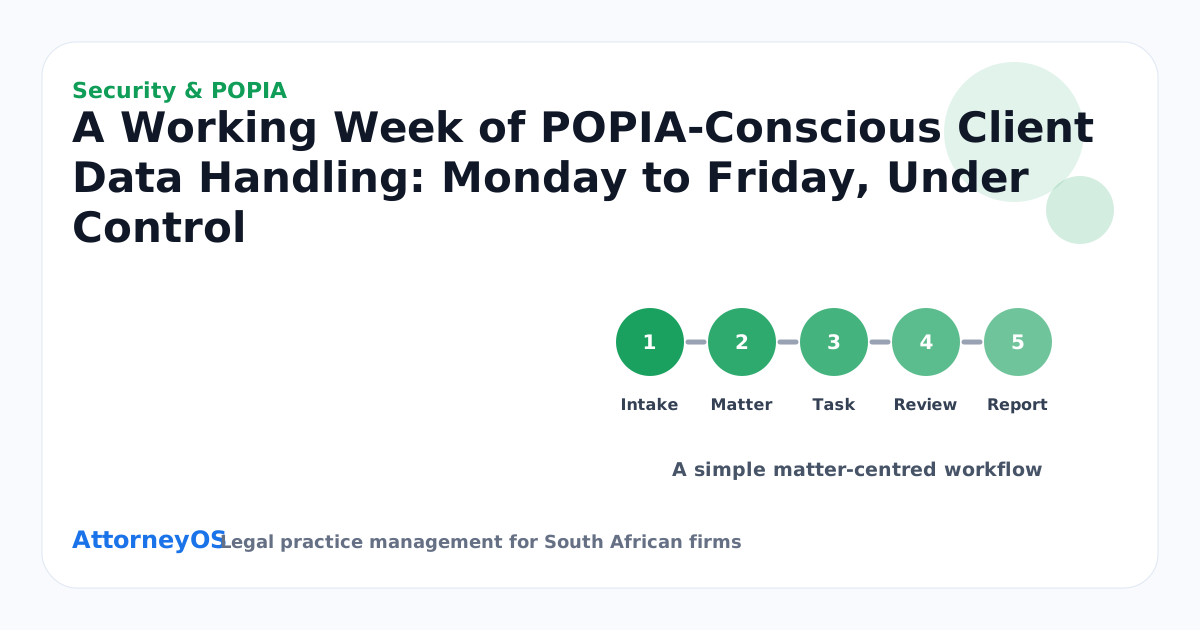
Monday morning starts with the week's picture, not the inbox: today's and this week's diary, the deadlines inside fourteen days, and the exception list — anything touching popia-conscious client data handling with no owner, no date or no movement. Fifteen minutes, same time every Monday, ideally before email. The output is not a feeling of readiness; it is a short list of decisions — what gets escalated, what gets reassigned, what gets a call today. Firms that skip Monday's look spend Friday discovering what it would have shown them.
Tuesday: the deep work day
Tuesday carries the substantive work, and the system's job is to protect it. Capture is quick and rough: whatever arrives touching popia-conscious client data handling goes onto the matter the same day — a line, an owner, a date — never into a notebook for later transcription that will not happen. The discipline that matters on heavy days is smallness: thirty seconds of capture now versus twenty minutes of reconstruction next week. By Tuesday evening the day's two-minute check asks only one question: does everything new have an owner and a date?
Wednesday: the day it goes wrong
Every week has one, and this week it is Wednesday: a court date moved with two days' notice. The measure of the system is what does not happen next. The interrupted work does not vanish — it sits on its matters with owners and dates, visibly displaced rather than silently dropped. Whoever picks up the emergency reads the picture from the record instead of interviewing the room. And when the fire is out, re-entry is a matter of reading the board again, not of remembering what Wednesday was supposed to be. Systems are bought for Tuesdays but paid for on Wednesdays.
Thursday: money and movement
Thursday holds the commercial look, because money left to month-end is money leaking. Unbilled work gets billed while context is fresh. Where popia-conscious client data handling has financial edges — amounts owed, disbursements, anything trust-adjacent — Thursday is when someone reconciles what the record says against what the accounts say, while differences are one week deep rather than one quarter. It is also the day client updates go out on matters that moved, and — harder discipline — on matters that did not, because clients chase silence, not delay.
Friday: close the week honestly
Friday afternoon, twenty minutes, the review that makes next Monday quick: everything in flight on popia-conscious client data handling gets a current status, a next action and a date, or it gets flagged as an exception on purpose. The test applied is the handover test — could a colleague run this from the record alone? Where the answer is no, the missing context gets written down now, in two sentences, while it is still obvious. A week closed honestly is the cheapest insurance the practice buys.
The rhythm in one list
- Limit personal information access to people who need it for the matter.
- Use audit logs for support access, settings changes and sensitive record updates.
- Keep client-facing and internal document visibility clearly separated.
- Anchor POPIA-conscious client data handling to fixed points in the week rather than to memory.
- End each day with a two-minute exception check: owners, deadlines, next actions.
- Close every week by clearing anything that has no owner or no date.
- Use a matter-centred workspace so popia-conscious client data handling is linked to clients, matters, tasks, diary, documents, billing and reports.
- Review the process with the responsible attorney and update the matter record before the week closes.
What the owner sees
Across that week the firm owner never once asked anyone for a status, because the questions answered themselves from the record: what is due, what is stuck, what is unbilled, who is overloaded. That is the quiet dividend of rhythm — supervision stops being interrogation and becomes reading. For searchers comparing POPIA law firms, this is the test worth running in any trial: can the owner see Monday's board, Wednesday's displacement and Friday's close without convening a meeting?
Making it stick
The rhythm survives on three protections. The fixed slots live in the diary like court dates, because an intention without a time is a wish. The routines are small enough to run on the worst week — fifteen minutes, twenty minutes, two — because a rhythm that needs a calm week will not survive practice. And one person owns the rhythm itself: not doing all the work, but noticing when a week's discipline slipped and calling the firm back to it before slippage becomes the new normal.
FAQ
What if the whole week is Wednesdays?
Then the rhythm matters more, not less. In a genuinely chaotic season the routines shrink to their minimum — capture stays daily, the weekly review drops to exceptions only — and the system holds the thread the humans cannot. The firms that abandon rhythm in chaos are the ones that never find out it was built for exactly that.
Does this need software?
The rhythm is free; the question is what carries it. Paper and memory carry it for one careful person. A shared system carries it for a firm — because Monday's board, Wednesday's handover and Friday's close all depend on the record being one place, current, and readable by whoever needs it next. That is less a feature than a definition of what practice management software is for.
Where to take this next
The routines above work on paper, in a spreadsheet or in software — but they hold up far better when the system enforces them instead of a person remembering to. AttorneyOS was built around exactly this operating rhythm for South African firms: popia-conscious client data handling lives on the matter alongside tasks, diary, documents, billing and trust records, so the discipline this article describes becomes the default rather than a resolution. When the firm is ready to test that on real work, the free trial runs 7 days with no card, and the first hour of setup is genuinely the checklist above.
Topics covered: Security & POPIA, POPIA, Security, Routine.
What the client notices
Clients cannot see the firm's systems, but they feel them. When popia-conscious client data handling is under control, the client experiences it as answers that arrive without being chased, updates that reference last month's conversation accurately, and invoices that reconcile with what was discussed. When it is not, the client experiences repetition — explaining the same thing to different people — and silence. Most clients forgive an unfavourable outcome far more readily than they forgive feeling unadministered.
Delegation needs a floor to stand on
A recurring small-firm complaint is that delegation fails — the work comes back wrong, so the senior attorney takes it back, and stays the bottleneck. Delegation usually fails on context, not competence: the junior was handed a task without the picture around it. When popia-conscious client data handling lives on the matter — history, next step, warnings — the picture travels with the work, and delegating becomes handing over a record instead of dictating a memory. That is the difference between delegation that sticks and delegation that boomerangs.
Keeping the paper trail honest
Every significant step in popia-conscious client data handling should leave a mark a stranger could follow: what was decided, by whom, when, and what evidence supported it. This is not bureaucracy — it is the firm's memory and, on a bad day, its defence. The test of a good trail is not volume but reconstructability: six months from now, could the firm show its reasoning without relying on anyone's recollection? Records made at the time, in the ordinary course, answer that question; recollections assembled afterwards do not.
What to measure after thirty days
Improvement in popia-conscious client data handling should be checkable, not felt. After thirty days, pull four numbers: items captured in the system rather than in inboxes, items with a named owner and date, exceptions surfaced by review rather than by accident, and the oldest unactioned item. If those four are moving, the change is real; if they are not, the process exists on paper only — and the honest response is to simplify it, not to abandon it.
The handover test
A reliable test for any Security & POPIA process: could a competent colleague take over tomorrow using only what is recorded? Where the answer is no, the missing piece is nearly always context — the why behind the next step, the warning that is obvious only to the person who has carried the file. Write those two things down as a habit and popia-conscious client data handling stops depending on any single memory, which is what resilience actually means in a small practice.